Here’s a situation you probably know. You read section 4.3 in your textbook, then you do the 20 problems for section 4.3. They go fine. Every problem uses the method you just learned, so you never have to wonder which method to use.
Then the exam comes. The problems are in random order, and suddenly the hard part isn’t solving them. It’s figuring out what kind of problem you’re looking at.
Think of a basketball player who only practices free throws, 50 in a row from the same spot. They’ll look great in practice. But in a real game, every shot is different, and they have to decide what to do in a split second. That’s the gap between homework and exams.
Interleaving closes that gap. You mix several types of problems together, so each one makes you stop and work out what it is first. It’s one of the better-supported study techniques in learning research, and it’s free: you use the exercises you already have, in a different order.
If you usually study by rereading your notes, this is a swap, not extra work. Rereading feels productive, but it never practices what the test asks: figuring out which method to use.
What is interleaving?
Interleaving (also called mixed practice) means shuffling different kinds of problems together when you practice. The opposite is blocked practice: you finish all the problems of one kind before you move to the next.
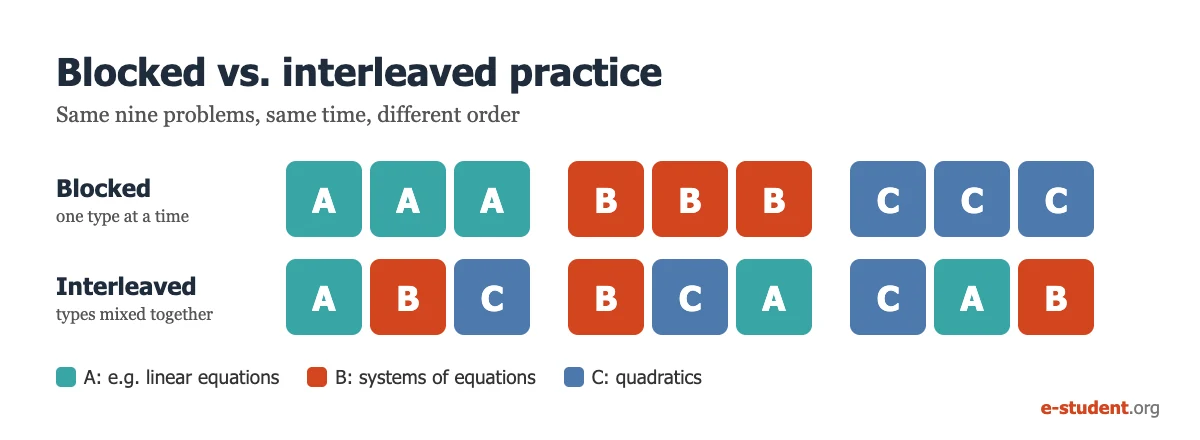
Say A, B and C are three types of problems. Blocked practice looks like AAA BBB CCC. Interleaved practice looks like ABC BCA CAB. It’s the same nine problems, but no two in a row use the same method.
One thing interleaving is not: studying several subjects in one day. An hour of biology followed by an hour of French is just a varied schedule. Interleaving happens inside one practice set, between topics that belong together, like mitosis and meiosis questions in biology, or different kinds of mole calculations in chemistry.
Is it the same as spaced repetition?
Not quite, but they’re related. Spaced repetition is about when you review: you come back to the same material after longer and longer breaks. Interleaving is about order: you put different types of problems side by side. The two overlap, because when you mix three types, you come back to each one after a short break.
Why does interleaving work?
Solving a problem takes two steps. First you choose the right method. Then you carry it out.
Blocked practice only trains the second step: if every problem on the page uses the Pythagorean theorem, you know the method before you read the question. Interleaving trains both steps:
- You learn to tell problem types apart. When a quadratic sits next to a system of equations, you have to notice what makes them different. That’s what exams test.
- You remember the method every time. In a mixed set, you pull the right method out of memory for every problem, not just once. That’s a form of active recall (practicing by pulling answers from memory instead of looking them up).
- You get spacing for free. Each type comes back after a short break, so you forget less between sessions (researchers call the speed of forgetting the forgetting curve).
How to build a mixed practice set
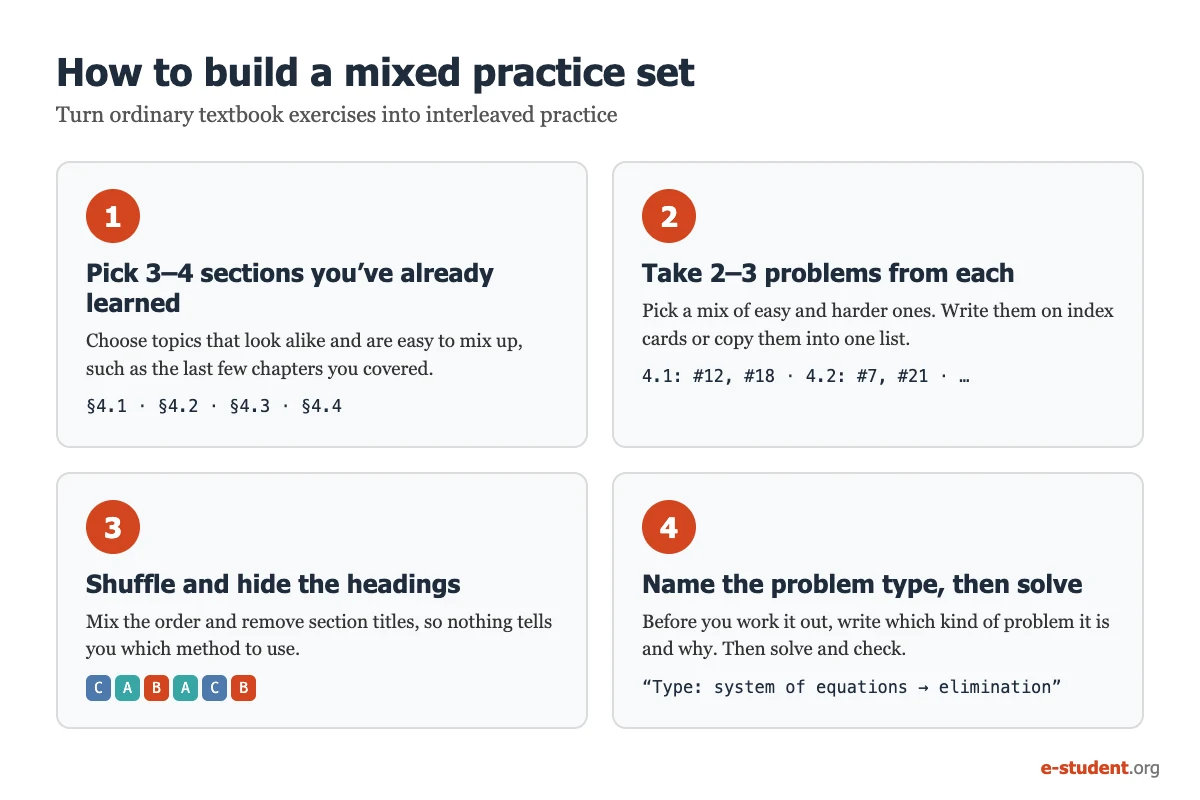
You don’t need any special materials. Your textbook or course already has plenty of exercises. They’re just sorted by section. Here’s how to re-sort them. Short version: pick, take, shuffle, name, solve, check.
Step 1: Pick 3–4 sections you’ve already learned
Choose sections you’ve worked through at least once. Ideally, pick ones whose problems could be mistaken for each other. A simple rule: the last three or four sections, plus one older topic you tend to forget.
Taking an online course? Use your last three or four modules or weeks instead. Old quiz questions, homework-site problems and practice exams all work. No exercises at all? Use end-of-chapter review questions, or write one question per concept from your lecture notes.
Step 2: Take 2–3 problems from each
Pick problems you were able to solve when you did that section. Middle-of-the-list ones are ideal, but if a topic still feels shaky, easier ones are fine. The point is choosing the method, not difficulty. Include a word problem if there are any, because that’s where choosing the method is hardest. If your exam mixes formats (multiple choice, short answer, diagrams), mix those too.
Step 3: Shuffle and hide the headings
Copy the problems by hand onto a sheet of paper or index cards, so the section or module name doesn’t come with them. Number them in a mixed order, and make sure no two problems in a row use the same method.
Step 4: Name the problem type, then solve
Before you start, write one short line: what type of question it is and which method or rule you’ll use. Most people skip this step, but it’s the one that trains you to tell problems apart. For example:
#4 Type: preterite vs. imperfect. Clue: “ayer” (yesterday), a finished action. Answer: preterite, so “compré.”
#2 Type: mitosis vs. meiosis. Clue: four cells, each with half the chromosomes. Answer: meiosis.
Can’t name the type? That’s useful to know. Mark the problem and come back to it after you’ve checked the others.
Step 5: Check answers and note your mix-ups
Check every answer. When you get one wrong, ask yourself: did I pick the wrong method, or did I pick the right one and make a mistake using it? Wrong-method mistakes are the ones interleaving fixes.
Keep a one-page “clue sheet” of the pairs you confuse and the clue that tells them apart, and put more of those pairs in your next set. You’ll probably get more wrong than on normal homework. That’s normal, and it means the set is doing its job.
Step 6: Repeat every few days with a new mix
Build a new set two or three times a week. Drop topics you always get right, and add new sections as you learn them. Over a semester, this turns into a rolling review of everything you’ve covered.
Examples by subject
Each example lists the mixed questions first and the answers after. Cover the answers before you start. Jump to: Algebra · Chemistry · Physics · Biology · Statistics · Spanish · Economics and history
Algebra
Say you’ve covered linear equations, systems of equations, quadratic equations and linear inequalities in Algebra I. Here’s one problem of each type, shuffled:
- Solve x² = 2x + 15.
- Solve −2x + 5 > 13.
- Two numbers add up to 30, and one is 6 more than the other. Find them.
- A gym charges a $20 joining fee plus $15 a month. After how many months will you have paid $110 in total?
Answers, with the type named first:
- Quadratic (move everything to one side first): x² − 2x − 15 = 0, (x − 5)(x + 3) = 0, so x = 5 or x = −3.
- Inequality: −2x > 8. Divide by −2 and flip the sign: x < −4.
- System (word problem): x + y = 30 and x = y + 6, so the numbers are 18 and 12.
- Linear equation (word problem): 20 + 15m = 110, so m = 6 months.
Notice the traps a page of same-type problems would hide:
- Problem 1 looks like a simple equation, but because x is squared, it’s a quadratic. You only see that if you stop and look.
- Problem 2 hides a classic slip: when you divide by a negative number, the “greater than” sign flips. In a block of inequalities, you’d remember. In a mixed set, you have to catch it yourself.
- Problem 3 never says “system,” but it gives you two facts about two unknown numbers, so you need two equations.
Chemistry
Stoichiometry (calculating amounts in a chemical reaction) is where many chemistry students pick the wrong method. Three of these questions use the reaction 2H₂ + O₂ → 2H₂O, and one is the odd one out:
- You have 4.0 g of H₂ and 16 g of O₂. Which one runs out first?
- How many moles of O₂ react with 4.0 mol of H₂?
- You dissolve 0.50 mol of NaCl in water to make 250 mL of solution. What’s the concentration?
- How many grams of water form from 8.0 g of H₂?
Answers, with the type and the clue:
- Limiting reactant (clue: two starting amounts). That’s 2.0 mol H₂ and 0.50 mol O₂. 2.0 mol H₂ would need 1.0 mol O₂, so O₂ runs out first.
- Mole ratio only (clue: moles in, moles out). The ratio is 2 H₂ : 1 O₂, so 2.0 mol O₂.
- Molarity (clue: a volume of solution). 0.50 mol ÷ 0.250 L = 2.0 mol/L.
- Gram to gram (clue: grams in, grams out). 8.0 g H₂ ≈ 4.0 mol, which makes 4.0 mol H₂O, or about 72 g.
Physics
Problems about motion, forces, energy and momentum often describe the same things (cars, balls, carts), and the challenge is spotting which rule applies. Use g = 9.8 m/s².
- A 2 kg cart moving at 3 m/s hits a 1 kg cart at rest, and they stick together. How fast do they move?
- A net force of 30 N acts on a 10 kg box. What’s its acceleration?
- A ball is dropped from 5 m. How fast is it going just before it lands?
- A car accelerates from rest at 3 m/s² for 4 s. How far does it travel?
Answers, with the type and the clue:
- Momentum (clue: “stick together”). 2 × 3 = 3v, so v = 2 m/s.
- Newton’s second law (clue: a force and a mass, nothing about time or distance). a = F/m = 3 m/s².
- Energy (clue: a height and a speed, but no time). v = √(2gh) ≈ 9.9 m/s.
- Kinematics, the math of motion (clue: a time and a distance). d = ½at² = 24 m.
Biology
Biology questions are often about processes that look alike. You’re not choosing a formula, but you still have to name which process the question is about.
- A cell divides and ends up as four cells, each with half the number of chromosomes. Mitosis or meiosis?
- In the nucleus, the cell makes an mRNA copy of a gene. Replication, transcription or translation?
- A skin cell divides into two identical cells to replace damaged skin. Mitosis or meiosis?
- At a ribosome, amino acids are joined into a chain by reading the mRNA. Replication, transcription or translation?
- Before a cell divides, it copies all of its DNA. Replication, transcription or translation?
Answers, with the clue: (1) meiosis: four cells, half the chromosomes. (2) transcription: DNA to mRNA. (3) mitosis: two identical cells. (4) translation: mRNA to protein. (5) replication: DNA to DNA.
Statistics
On a statistics exam, the hard part is usually choosing the right test or measure, not the arithmetic. For each question, name what you’d use:
- The same 20 patients have their blood pressure measured before and after taking a drug. Did it change?
- Home prices in a town include a few mansions. Which better describes a typical price, the mean or the median?
- Exam scores follow a normal distribution with a mean of 70 and a standard deviation of 10. What share scored above 85?
- Compare the average hours of sleep of 30 night-shift nurses and 30 day-shift nurses.
Answers, with the clue: (1) paired t-test: the same people, measured twice. (2) median: a few extreme values pull the mean up. (3) z-score: a known mean and standard deviation, and a question about a share of values. z = (85 − 70) ÷ 10 = 1.5, so about 7% scored above 85. (4) two-sample t-test: two separate groups.
Spanish
In Spanish grammar, the hard part is usually deciding which form to use. This drill mixes three pairs: preterite vs. imperfect (past tenses for finished vs. ongoing actions), ser vs. estar (two verbs for “to be”), and por vs. para (two words for “for”).
- Cuando era niño, ___ (vivir) en Madrid.
- Gracias ___ la ayuda. (por/para)
- Ayer ___ (comprar) un libro.
- La fiesta ___ en mi casa. (ser/estar)
Answers, with the type and the rule:
- vivía (preterite vs. imperfect): ongoing background in the past, so imperfect.
- por (por vs. para): thanks for something, an exchange, so por.
- compré (preterite vs. imperfect): a finished action at a specific time, so preterite.
- es (ser vs. estar): where an event takes place uses ser. That’s a classic trap, because the location of a thing or person uses estar.
To make your own from a workbook, practice a new pair on its own first. Then copy 3–4 sentences from each of a few chapters onto one sheet in mixed order, and write the type in brackets before each answer.
Economics and history
Concept-heavy classes are less tested, but worth trying. Mix things you could confuse, and name which is which before you answer. In intro economics, a classic mix-up is a shift of the demand curve vs. a movement along it:
- The price of coffee goes up, and people buy less coffee.
- A study says coffee is healthy, and people want more coffee at every price.
- The price of tea (which many people drink instead of coffee) falls. What happens to the demand for coffee?
Answers: (1) a movement along the curve, because coffee’s own price changed. (2) demand shifts right, because tastes changed. (3) demand for coffee shifts left, because a substitute got cheaper. The clue: if the good’s own price changed, it’s a movement along the curve. Anything else shifts it.
In history, mix short questions about the causes of different wars or revolutions, and say which one each is about before you answer (for example, the assassination of Archduke Franz Ferdinand belongs to World War I, the invasion of Poland to World War II). Plain dates and names work like vocabulary, so use spaced repetition for those.
When should you interleave (and when not)?
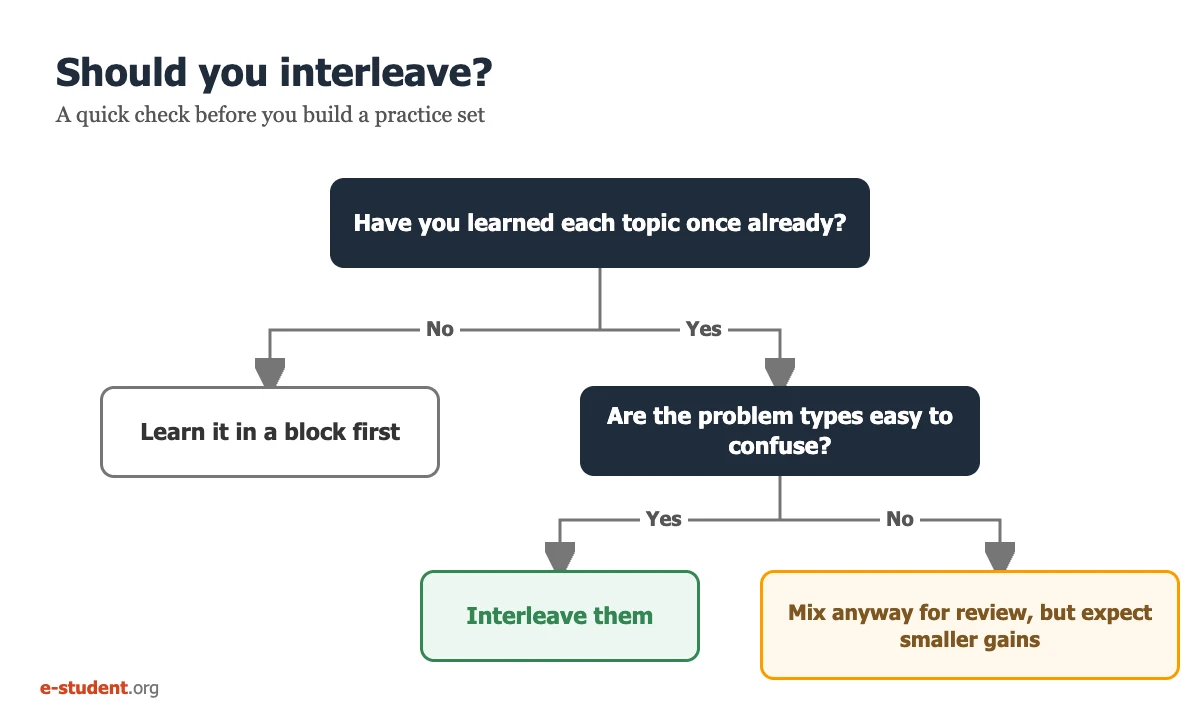
- Learn new things in a block first, then mix. When a method is brand-new, a short block of practice helps you get the steps right. Start mixing once you can do each type on its own, even if you’re slow.
- Mix things you could mix up. The easier it is to pick the wrong method (preterite vs. imperfect, permutations vs. combinations, momentum vs. energy), the more mixing helps.
- Don’t mix unrelated subjects in one set. Alternating chemistry and Spanish questions won’t teach you anything, because you’d never confuse the two.
- Use spacing, not mixing, for plain facts. In a review of 59 studies, studying one group at a time beat mixing for word lists. For plain definitions, vocabulary, dates and names, spaced repetition matters more. Terms that are easy to confuse are different: mitosis vs. meiosis or tissue types on a microscope slide are worth mixing, because the hard part is telling them apart.
What a week can look like
New material gets a short block first (your regular homework already does this), and a mixed set comes on top. Here’s an example for Algebra I:
| Day | New material (blocked) | Mixed set (interleaved) |
|---|---|---|
| Monday | Quadratics: 6 problems | 8 problems: linear equations, systems, inequalities |
| Tuesday | Quadratics: 6 more | None |
| Wednesday | Quadratic formula: 5 problems | 8 problems: all four types |
| Thursday | None | 10 problems, heavy on the pair you mix up |
| Friday | Inequality graphs: 5 problems | 8 problems: all four types plus 1 older topic |
| Weekend | None | 12 problems as a mini exam, no notes |
Evenings and weekends only? Two mixed sets a week is enough: one on a weeknight (8 problems, 20–30 minutes) and one on the weekend (12 problems including an older topic, no notes). Your regular homework is already your blocked practice, so the mixed sets are the only extra.
Short on time or cramming? Interleaving works best spread over weeks. But if your exam is in two days, still do one mixed set of past homework or quiz questions instead of rereading, because the exam will be mixed. Next time, start a couple of weeks earlier and add spaced repetition.
How to interleave your flashcards
Put a problem or sentence on the front of each card and the type, method and answer on the back. Then shuffle cards from different chapters together, so every card makes you choose.
Anki, step by step:
- Group related decks. Rename them with a shared first part and two colons, like Spanish::Preterite and Spanish::Imperfect. Anki puts both inside a “Spanish” deck. Click Spanish to study them in one session.
- Shuffle fully with a filtered deck. Go to Tools > Create Filtered Deck, type deck:Spanish in the search box (this includes its subdecks), set “Cards selected by” to Random, and click Build. When you delete the filtered deck, the cards go back to their usual decks.
- Or use Custom Study. Click a deck, then the Custom Study button at the bottom, and choose “Study by card state or tag.”
Quizlet: turn on Shuffle in Flashcards mode, and use Combine to study several sets together (for now, you can only combine sets on the website).
Paper cards: shuffle cards from several chapters into one stack. A Leitner box (a box with a few sections, where cards you know move to sections you review less often) does this naturally if you file cards from different topics into the same sections.
Common mistakes
- Giving up because it feels harder. Mixed sets are slower, and you’ll make more mistakes while practicing. That’s the point: the extra effort is where the learning happens. Judge the method by your test results, not by how practice feels.
- Skipping the naming step. If you jump straight into solving, you’re not practicing the choice of method, and that’s most of the benefit.
- Peeking at the chapter. Flipping back to see which section a problem came from turns your mixed set back into a blocked one. Try first, check later.

What does the research say?
Short version: in real math classes, students who mixed their practice did much better on tests weeks later, and mixing helps most when things are easy to confuse.
The clearest result. In a study by Doug Rohrer’s team at the University of South Florida (Rohrer, Dedrick & Stershic, 2015), 126 seventh graders practiced two math skills over three months, one mixed and one in blocks. On a surprise test a month later, they scored 74% on the mixed skill and 42% on the blocked one. One day after the final review, the gap had been smaller (80% vs. 64%), so the advantage grew over time.
Why it feels wrong. In Kornell & Bjork (2008), students learned the styles of 12 painters, either one artist at a time or mixed. Most people did better with the mixed order, yet most of them believed the one-artist-at-a-time order had worked as well or better. Psychologists Robert and Elizabeth Bjork call methods like this desirable difficulties: practice feels harder, but what you learn lasts longer, as long as you know enough to handle the difficulty.
More results:
- Two more math studies by the same team found similar gaps: 72% vs. 38% two weeks later (2014), and 61% vs. 38% a month later in a trial with 54 seventh-grade classes (2020).
- A review of 59 studies (Brunmair & Richter, 2019) found a moderate benefit overall: largest for telling apart things you learn by looking (like paintings), small but clear for math, unclear for reading texts, and negative for word lists.
An honest caveat: most of the strongest results come from math classes and lab tasks like the painting study. There’s less direct evidence for things like history essays or vocabulary. If you try interleaving there, treat it as a sensible experiment, not a proven method.
How interleaving fits with other study methods
A mixed set is active recall by design, and rolling sets where older topics keep coming back give you spaced repetition without a special schedule. If there’s a concept you keep confusing, try explaining it with the Feynman technique. And if long mixed sets wear you out, split them into Pomodoro sessions. For an overview of how all these methods compare, see our guide to the best study methods.
Interleaving FAQ
What is interleaving in studying?
Interleaving means mixing different types of problems in one practice session. For example, you solve linear equations, systems and quadratics in a shuffled order instead of one type at a time. It trains you to recognize which method each problem needs.
What’s the difference between interleaving and spaced repetition?
Spaced repetition is about timing: you review the same material after longer and longer breaks. Interleaving is about order: you put different problem types next to each other. Mixing creates some spacing on its own, and the two work well together.
Does interleaving work for every subject?
Not equally. The evidence is strongest for math and for learning to tell things apart by looking, such as painting styles. It works best for problem-solving subjects like math, physics, chemistry and statistics, and for things that are easy to confuse, like mitosis and meiosis. For concept-heavy classes like economics or history, there’s less evidence, but mixing questions about concepts you tend to confuse is a reasonable experiment. For plain vocabulary, dates and names, spaced review works better than mixing.
Should I interleave when learning something new?
Usually not right away. Practice a new method in a short block until you can do it on your own, then add it to your mixed sets. Interleaving helps you tell methods apart, which only makes sense once you know each method.
How many problem types should I mix?
Three or four types, with two or three problems each, is a good start. That’s enough variety to practice choosing a method, while you still see each type more than once.
Why does interleaving feel harder if it works better?
Because you have to work out the method for every problem instead of repeating the same one. Blocked practice feels smooth, and people tend to mistake that smooth feeling for learning. In one study, most students said blocked practice was as good or better, even though they had done better with mixed practice.
Your next step
Interleaving is a small change: the same exercises, in a different order, with one extra line where you name the type. Learn each topic in a block first, then mix the ones you might confuse, and stick with it even though it feels harder.
Tonight: pick your last three topics, copy two questions from each onto one sheet in mixed order, and write the type before you answer each one. It takes about 20 minutes, and it’s a better use of that time than rereading.