Here’s a situation you probably know. It’s Sunday evening, and you decide this week will be different. You’ll start the essay on Monday and finish the next module of your course. You can already picture it: the work handed in early, the good grade, the relief.
Then Monday comes. You get home tired, pick up your phone “for five minutes,” and it’s 11 pm. By Thursday, you’re where you were last week.
The plan wasn’t the problem. The problem is that it stopped at the nice picture. Psychologist Gabriele Oettingen has spent decades studying how people think about their goals, and she found something surprising: the more people daydreamed about a perfect outcome, the less effort they tended to put in.
WOOP is the method she built from that research. It doesn’t ask you to stop dreaming. It asks you to put the dream next to the thing most likely to stop you, and decide in advance what you’ll do when that happens.
That’s a complete WOOP, plus a reminder. Want to see it in action first? Jump to the examples.
What is the WOOP method?
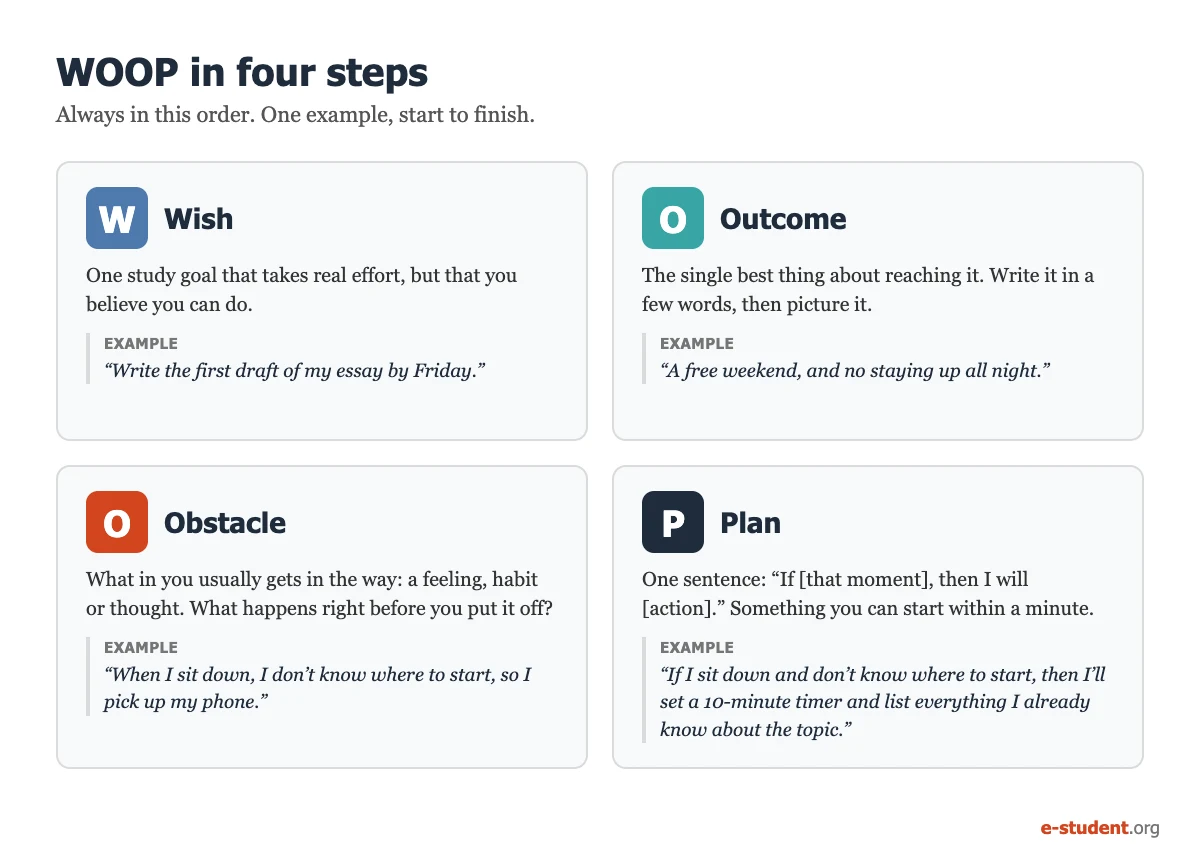
WOOP is a short mental exercise for turning a goal into action. You go through four steps, always in this order: Wish (what you want), Outcome (the best thing about getting it), Obstacle (what in you is most likely to get in the way) and Plan (what you’ll do when it does).
Who developed WOOP?
Gabriele Oettingen, a psychology professor at New York University and Zeppelin University in Germany, developed WOOP and popularized it in her 2014 book Rethinking Positive Thinking. The Plan step builds on psychologist Peter Gollwitzer’s research on if-then plans (Gollwitzer, 1999).
Isn’t that just positive thinking?
It’s closer to the opposite. Picturing success on its own can leave you with less energy. But confidence isn’t the problem. In Oettingen’s studies, people who expected to succeed tended to put in more effort and do better than people who didn’t. Thinking only about obstacles doesn’t help much either. What counts is the order: outcome first, then obstacle.
Why does WOOP work?
Here are the three main ideas behind it:
- The obstacle turns a daydream into a task. When you think about the obstacle right after the outcome, it becomes what stands between you and something you want. According to Oettingen, that gives you a reason to act.
- It helps you commit to the right goals. In lab experiments, people who thought about a wish and then its obstacle committed more to goals they expected to reach, and less to goals they didn’t (Oettingen, Pak & Schnetter, 2001). Not every later study has found this, but it’s a good reason to pick a wish you believe in (Step 1).
- The plan makes the decision before the hard moment. When you’re tired, with your phone in hand, choosing to study is hard. With an if-then plan, you’ve already made that choice while you were calm, so in the moment, you follow the plan instead of deciding again.
How to WOOP, step by step
Before you start: find a few minutes when nobody will interrupt you, and close everything except your notes. You can do a WOOP in your head, on paper or in the free WOOP app, but writing it down is easier at first.
Step 1: Choose your wish
Pick one thing you want to get done, in whatever timeframe fits: today, this week or this semester. A good wish is:
- Important to you. Something you care about, even if it’s for a course you have to take.
- Challenging, but believable. It should take real effort, and you should honestly think you can do it.
- Specific enough to picture. “Do better in school” is hard to imagine. “Get a good grade on Thursday’s chemistry quiz” is easy.
If you doubt you can do it, make the wish smaller. WOOP may make you less committed to a wish you don’t believe in. So if your goal feels too big (“pass all my exams,” “become a nurse”), don’t drop it: shrink this week’s wish until you believe it (“pass Thursday’s quiz”). Small wins can rebuild confidence, and you can do a new WOOP for the next step.
Stress and tiredness can make any goal feel impossible. That doesn’t mean the goal is wrong; it means this week’s step should be smaller.
Step 2: Picture the best outcome
Ask yourself: what’s the single best thing about reaching this wish? It can be a feeling (“relieved,” “proud”) or a result (“I’ll have Sunday free”). Write it in a few words, then take a moment to really imagine it: where you are, how it feels.
What if the wish is an assignment you don’t care about? Look for an outcome you do care about: a free weekend, proof to yourself that you can do it, or making your family proud.
Step 3: Name the obstacle inside you
Now ask: what is it in me that usually gets in the way? This isn’t about finding a flaw. You’re looking for the moment where things usually go wrong, so you can plan for it. A useful question: what usually happens right before I stop or put it off? Most answers fit one of these:
- A feeling: “I feel anxious when I see how much there is to read.”
- A habit: “I reach for my phone whenever a problem gets hard.”
- A thought: “I tell myself I work better under pressure.” Or: “I tell myself I’m too old for this.”
Your first answer is often something outside you, like “my phone,” “no time” or “my professor is unclear.” If so, ask why that stops you. Why does my phone win? Maybe because “I tell myself there’s plenty of time.” That’s the obstacle you can plan for.

If your obstacle is a practical problem, fix that first. Some obstacles really are outside you: no internet at home, shifts that change every week, a child who won’t sleep. WOOP can’t fix those, so solve what you can directly (study at the library, take turns putting the kids to bed). Then WOOP what’s left. Often that’s a thought about the time you do have, such as “20 minutes isn’t worth starting.”
Once you’ve found your obstacle, picture the moment it usually happens.
Step 4: Make your if-then plan
Now write what you’ll do in that moment:
If [obstacle or the moment it shows up], then I will [action].
The “if” can be the obstacle itself (“If I think ‘I’ll start tomorrow’”) or the situation where it usually shows up (“If my 8 pm alarm goes off,” “If I get home from work”). If your problem is starting, the second kind is usually easier: it’s hard to notice a passing thought, but you can’t miss an alarm.
The “then” should be short and concrete: something you can start within a minute. “Then I’ll try harder” isn’t a plan. “Then I’ll do just the first question” is. It can be:
- An action: “…then I’ll put my phone on the charger in the kitchen.”
- A thought: “…then I’ll tell myself, ‘Ten minutes still counts.’”
- A break: “…then I’ll take a 10-minute walk.” That’s a good plan if your obstacle is studying for hours without stopping.
Stick to one plan per WOOP. For other obstacles, do another WOOP.
Make it hard to forget. When you’re tired or distracted, it’s easy to forget a plan. Type your plan into the label of an alarm, put a sticky note where the moment happens (on your laptop or the TV remote), or set up the “then” in advance (leave the book open).
WOOP examples for your situation
Each example is a complete WOOP. Find the one most like you.
You haven’t started at all
- Wish: Write the first draft of my essay by next Friday.
- Outcome: Not staying up all night before it’s due.
- Obstacle: I tell myself there’s plenty of time, so every evening I pick up my phone instead.
- Plan: If my 8 pm alarm goes off, then I’ll put my phone on the charger in the kitchen and write for 15 minutes.
You start, then get stuck and give up
- Wish: Finish this week’s math problems on time.
- Outcome: Not falling behind in a class that matters for my degree.
- Obstacle: When I’m stuck on a problem, I feel stupid and give up on the whole set.
- Plan: If I’ve been stuck on one problem for 15 minutes, then I’ll mark it to ask about in class and move on.
You study for hours, but it isn’t working
- Wish: Solve this week’s thermodynamics exercises before looking at the solutions.
- Outcome: Following the next tutorial instead of feeling lost.
- Obstacle: When I don’t understand something, I reread the slides for hours, because trying a problem and failing feels worse.
- Plan: If I’ve read the same slide twice without understanding it, then I’ll close the slides and try the first problem for 15 minutes.
You study after work, with a family
- Wish: Finish module 4 of my online certificate in the next two weeks.
- Outcome: Halfway through the certificate, so the monthly fee feels worth it.
- Obstacle: When the kids are finally asleep, I tell myself 20 minutes isn’t worth starting, and I turn on the TV.
- Plan: If the kids are asleep and I think “20 minutes isn’t worth it,” then I’ll watch one lecture video at the kitchen table.
You doubt you can do this
- Wish: Pass next Thursday’s quiz on the skeletal system.
- Outcome: Proof to myself that I can still learn this.
- Obstacle: When I can’t remember a term, I think “I’m too old for this” and close my tablet.
- Plan: If I think “I’m too old for this,” then I’ll tell myself, “New terms take a few tries for everyone,” and do five more flashcards.
You have to send something you’re nervous about
- Wish: Send chapter 2 of my thesis to my supervisor by Friday.
- Outcome: Real feedback instead of guessing, and no more worrying about the chapter.
- Obstacle: When the draft is almost ready, I’m afraid it isn’t good enough, so I start rewriting the introduction again.
- Plan: If I open the draft on Friday and want to rewrite something, then I’ll write my questions for my supervisor at the top and press send.
A WOOP worksheet you can copy
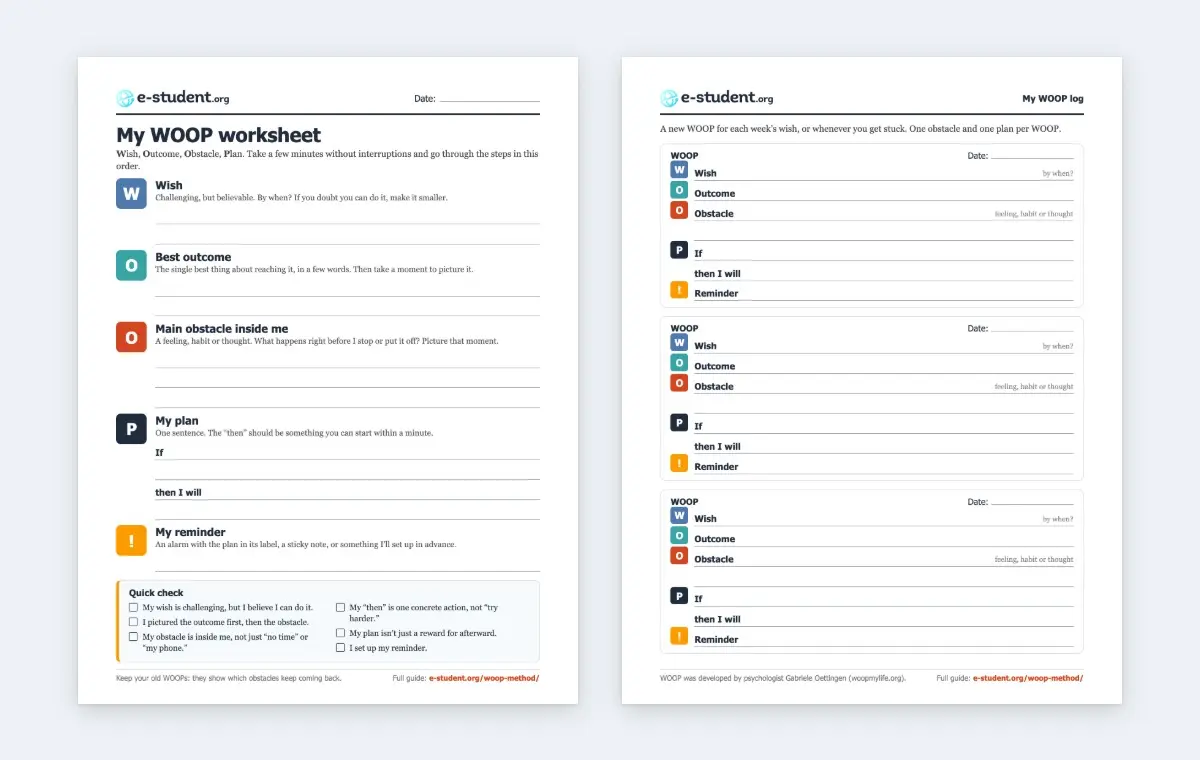
Copy this into a notebook or your phone. Keep your old WOOPs: they show which obstacles keep coming back.
Prefer paper? Download our printable WOOP worksheet (PDF, 2 pages). Page 1 walks you through one WOOP with a quick checklist, and page 2 has room for three more.
When to use WOOP (and when it helps less)
Good times to use WOOP:
- Goals you keep putting off. If you’ve said “I’ll start next week” three weeks in a row, that’s a good wish.
- A moment that keeps going wrong, such as after dinner or your first 10 minutes at your desk. If-then plans are designed for these.
- Each week, or whenever you get stuck. Don’t rely on one WOOP at the start of a course to last until the end. Do a new one for each week’s wish.
WOOP helps less when:
- The obstacle is practical, such as no internet or no childcare. Fix that first (Step 3).
- Something bigger is going on. If anxiety or low mood stops you from studying most days, WOOP isn’t a substitute for support. Talk to a counselor at your school or university, or to a doctor.
If it’s not working, check these
A WOOP that isn’t helping may only need adjusting:
- Is your obstacle inside you? If you wrote “no time” or “my phone,” ask why it stops you (Step 3).
- Did you picture the outcome and the obstacle? It’s easy to rush through them. Give each one a moment.
- Is your plan just a reward? “If I study for an hour, then I’ll watch YouTube” is a treat for afterward. It does nothing about the moment you get stuck.
- Is the wish the right size? If you keep missing it, make it smaller. If your situation has changed, do a new WOOP.
What does the research say?
Short version: in randomized studies (where chance decides who gets WOOP and who doesn’t), WOOP tends to help students and adults act on their goals. But the effects are modest, and in the biggest studies, which were in online courses, they were very small or faded quickly. In research papers, WOOP is called mental contrasting with implementation intentions (MCII).
Daydreams and effort. In one of Oettingen’s studies, students with more positive fantasies about their grades studied less and improved their grades less (Oettingen & Mayer, 2002). That study only observed students, but small lab experiments point the same way: picturing an ideal week ahead left people with less energy than a comparison group (Kappes & Oettingen, 2011).
High school students. In a small study, 66 students did either a 30-minute written WOOP exercise or a different writing task before the summer. Between July and October, the WOOP group completed about 140 practice questions for the PSAT (the Preliminary SAT, which many US students take before the SAT college-entrance exam), versus about 84 for the other group, or more than 60% more (Duckworth et al., 2011). The study counted practice questions, not test scores.
Doctors and university students. Thirty-four resident doctors (doctors still in training) were randomly assigned to learn WOOP or goal setting. Over three weeks, the typical WOOP resident reported 4.3 hours of study toward their goals, versus 1.5 hours with goal setting (Saddawi-Konefka et al., 2017). And in a study with 40 university students, those taught WOOP and asked to use it every day for a week reported using their time about 15% better than the week before, while a comparison group that practiced a similar-looking mental exercise reported no real change (Oettingen et al., 2015).
Online courses. In two experiments with about 18,000 learners, an eight-minute WOOP-style writing exercise made learners in individualist countries, such as the US, 15% to 32% more likely to finish. It made no difference in less individualist countries, such as India and China, where family and group goals often come first. The researchers suggest the method may fit individualist thinking better. It also helped only when the main obstacle was predictable and manageable, such as work or family duties, not a lack of time or internet. Across all learners, though, the effect was very small (Kizilcec & Cohen, 2017).
A much bigger test. In a later study with more than 250,000 students in 247 online courses, the same kind of WOOP exercise raised engagement for only about a week and didn’t change how many students finished. The earlier difference between countries didn’t show up again either (Kizilcec et al., 2020).
The big picture. A 2021 review of 21 real-world studies found that WOOP helped people reach their goals by a small-to-medium amount, and a little less for school goals, though that comparison rested on only five school studies and the difference wasn’t statistically significant. Because studies with positive results are more likely to be published, the authors note the real effect may be smaller still (Wang, Wang & Gai, 2021).
An honest caveat: most WOOP studies are small, most involve the method’s developers, and the largest studies show the smallest effects. The research supports WOOP as a quick, free way to help you act on a goal, not as a guarantee.
What this means for you (our advice, not a research finding): do a new WOOP whenever you get stuck, rather than relying on just one. If personal wishes don’t motivate you much, try an outcome tied to people who matter to you, such as your family. No study we know of has tested this, but it costs nothing to try.
How WOOP fits with other time management methods
WOOP helps you follow through, so it pairs well with methods for deciding what to do and when:
- The Eisenhower Matrix sorts tasks by urgency and importance. “Important but not urgent” tasks, like starting an essay early, suit WOOP well, because no deadline is pushing you yet.
- Time blocking gives each task a slot in your day, and a WOOP protects the slot: “If my 7 pm study block starts and I want to watch one more episode, then I’ll turn off the TV.”
- The Pomodoro technique makes a good “then”: “If I don’t feel like starting, then I’ll do just one 25-minute Pomodoro session.”
WOOP FAQ
How long does a WOOP take?
A few minutes without interruptions. For a small problem you’re facing right now, the official WOOP site says about 30 seconds can be enough.
How often should I do a WOOP?
As often as you have wishes, says the official site. You don’t need to redo a WOOP that’s working.
Is WOOP the same as SMART goals?
No. SMART goals (a popular checklist for writing clear goals) help you define what you want. WOOP adds the obstacle and a plan for it. A SMART goal makes a good wish.
Your next step
WOOP is small: four steps, a few minutes, one sentence that moves your decision from the hard moment to a calm one.
Tonight: pick one study task for this week, not necessarily the biggest. Write your wish, picture the best outcome, name what usually happens right before you stop, and write one “If…, then I will…” sentence. Then set the alarm or put the note where that moment happens. If it doesn’t help the first time, adjust it and try again.