
Contents
- What is Coursera?
- History of Coursera
- How much does Coursera cost?
- Coursera’s online courses
- Coursera’s specializations
- Coursera’s Professional Certificate programs
- Coursera’s MasterTrack programs
- Coursera’s online degrees
- Coursera for Business (B2B)
- Common Coursera complaints (and my honest take)
- Review conclusion: Is Coursera worth it?
- Coursera alternatives
- Coursera FAQ
- Learn more: Coursera course & certificate reviews
Coursera
➔
★★★★★ 4.5 / 5
Coursera’s breadth is hard to beat — thousands of university- and industry-backed courses, most of them free to audit — and the teaching quality is genuinely excellent, which is why it’s still one of my favourite platforms. My one real reservation isn’t the learning at all: it’s the billing. Auto-renewing subscriptions and refunds hedged with fine print are where almost all the complaints land, so go in knowing exactly how the payments work.
Pros
- Most courses are free to audit
- Huge, high-quality catalogue from real universities and companies
- Degrees are fully accredited and internationally recognised
- Respected career certificates (Google, IBM, Meta)
- Coursera Plus is excellent value for frequent learners
- Coursera Coach AI tutor plus a strong enterprise offering
Cons
- Confusing subscription billing and easy-to-miss auto-renewal
- Refunds limited by fine print; support is weak on billing disputes
- Free auditing excludes graded work and certificates
- MasterTrack catalogue has shrunk, and degrees are pricey
Get 40% off your first year of Coursera Plus Annual — unlimited access to 10,000+ courses (new subscribers only)
Coursera as a platform has been growing exponentially. The number of registered learners on Coursera has grown rapidly, and it’s now the learning platform of choice for over 197 million registered learners. It’s also the online education platform of choice for large corporations such as Adobe and MasterCard for workforce training. At first glance, Coursera seems like the perfect platform for learning any topic online. To see whether that’s still really the case in 2026, I will have a deeper look into the platform in this review of Coursera, taking into account recent changes to the platform and pricing.
What is Coursera?
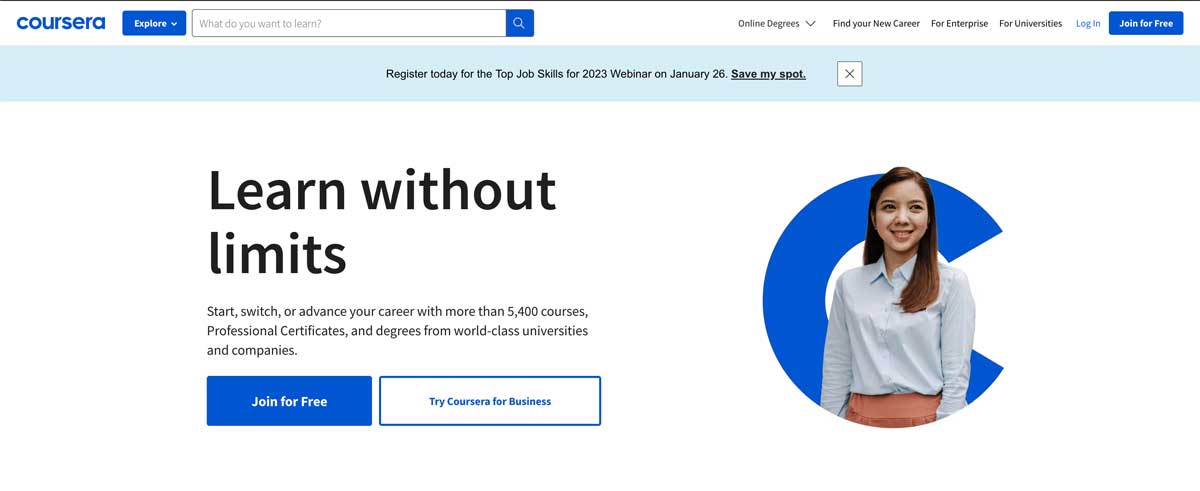
Coursera is one of the world’s leading online education websites. Partnering with some of the leading universities around the world, Coursera provides massive open online courses (MOOCs), professional certificates, micro-credential programs, and online degrees. It was one of the first MOOC companies to reach “unicorn” status, and in March 2021 it went public on the NYSE (ticker: COUR). It’s been designed specifically for students who want to reap the benefits of studying online, without sacrificing university-level quality. In this Coursera review, you will find out why exactly that is.
To give you a quick overview of the platform, here are some recent key numbers about Coursera’s offerings in 2026:
- 197+ million registered learners
- 10,000+ online courses and projects
- 2700+ Specializations
- Hundreds of Professional Certificate programs
- A small selection of MasterTrack micro-credential programs
- Dozens of online Bachelor’s degrees and Master’s degrees
- 21 online Graduate Certificates
- 1,700+ enterprise customers, including Adobe and the Abu Dhabi School of Government
In the course of this review of Coursera, you will learn what these various learning programs mean and whether they are a good fit for you. However, before that, let’s have a quick look at the history of Coursera and how it became such a giant in the e-learning industry.
History of Coursera
Coursera was founded in 2012 by two computer science professors from Stanford University – Andrew Ng and Daphne Koller. However, Andrew Ng started playing around with online learning software much earlier than that. In 2008, he developed the Stanford Engineering Everywhere (SEE) program, which delivered three Stanford courses on machine learning, databases, and AI to online students for free. Each of these three online courses gathered signups of 100,000 students or more, as detailed by Andrew himself. Seeing such demand for online classes sparked Andrew’s enthusiasm even more, and before long, he started actively developing Coursera together with co-founder Daphne Koller.
Going back in time to 2012, take a look at this interview with Daphne Koller, co-creator of Coursera. When she gave this talk, Coursera only had 43 online courses available. In the ten years since that number has grown more than a hundred-fold to over 10,000 courses (plus thousands of shorter guided projects).
Andrew and Daphne saw so much potential in this type of e-learning that they put their careers as professors at Stanford on hold and started focusing solely on the MOOC site. Looking back on it, they made the right choice: the company they founded grew from a Stanford side-project into a publicly traded company that reported $757 million in revenue in 2025.
Neither founder runs Coursera today: Jeff Maggioncalda was CEO from 2017 to 2025, and Greg Hart became CEO in February 2025. Andrew Ng and Daphne Koller are no longer involved in day-to-day management. They are, however, still highly active in entrepreneurship. In 2018, Daphne Koller founded Insitro, an innovative company that intertwines drug discovery and machine learning. Around the same time, Andrew revealed the “AI Fund” that would invest hundreds of millions of dollars in artificial intelligence projects.
Coursera is now an established, publicly traded leader in online education — a long way from its 2012 origins.
How much does Coursera cost?
Coursera’s cost depends on the type of online class.
- Individual Coursera courses cost $29 to $99. In most cases, they can be audited for free.
- Coursera’s specialization programs are based on monthly payments of $39 to $89.
- The Coursera MasterTrack certificate programs cost beginning from $2,000, with some costing up to $5,000.
- Most online Bachelor’s and Master’s degrees cost between $10,000 to $50,000. A few cost less, an MBA for $6,000 and a Bachelor’s in Computer Science for $4,000-6,000, both offered by leading universities in India.
Coursera Plus is Coursera’s yearly subscription service through which learners can access all 10,000+ Coursera courses, projects, and specializations, as well as many of the professional certificates, with unlimited access. At $59/month or $399 annually, the plan offers excellent value for students who take online courses frequently.
Is Coursera worth it?
Yes, Coursera is legit and worth the cost for anyone who wants to pursue online learning with leading academic institutions. Coursera is one of the most cost-effective MOOC sites currently out there. Thousands of university-backed online courses make it highly appealing for MOOCs, and the new subscription-based Coursera Plus offers excellent value for frequent online students.
How does Coursera make money?
Coursera’s yearly revenue is estimated to be around $757 million in 2025, most of which comes from paid online courses, Specializations, MasterTracks, online degrees, and enterprise clients. The global corporate e-learning market size is growing astonishingly quickly, and it’s also becoming an increasingly large portion of Coursera’s revenue.
Coursera’s online courses
Now, it’s time to review Coursera’s most important feature – Coursera’s online course catalog. As of the latest update of this Coursera review, more than 10,000 online courses are available on the platform, with new ones added constantly. On top of that, there are also over 4,000 short standalone projects of various kinds.
Coursera’s courses are delivered in partnership with leading universities or with leading industry actors, such as Google and Nvidia. This is a significant benefit of Coursera compared to other platforms such as Udemy. Online courses on Udemy don’t always have university support and tend to be developed by an independent instructor. There are certainly some fantastic courses on these kinds of platforms as well. However, there’s no getting around the fact that they also have a lot of low-quality cash-grab courses created by instructors who are not actual experts.
With Coursera, you at least know that any course you pay for has university-level quality assurance.
Coursera’s model is very similar to edX, but has a different catalog, more developed higher-end offerings in terms of degrees and certificates, and a more streamlined interface.
How do Coursera’s courses work?
Coursera’s courses, for the most part, work similarly to other online course providers. The syllabuses on Coursera are split into weekly units, and the online courses usually involve the following types of learning materials:
- video-based lectures
- online reading materials
- quizzes
- peer-graded assignments
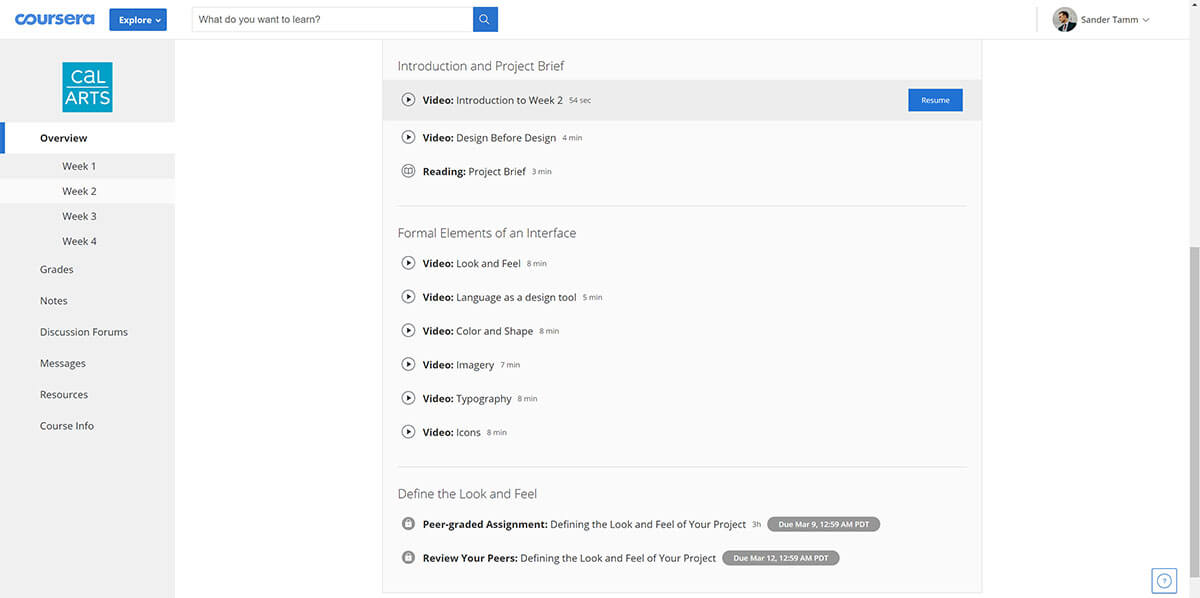
After soaking up the knowledge through video lectures and reading materials, you are usually given a quiz to test your knowledge. Depending on the course, the first learning week might not include a quiz, but every course on Coursera that I’ve seen has included quizzes at some point in the curriculum. Peer-graded assignments usually start later in the syllabus, as they already require a considerable amount of knowledge and skills in the student.
It should be noted, however, that not all of these features are free to access. In most cases, auditing an online course on Coursera is free, meaning you can review all the learning material at no cost. Auditing, however, does not include quizzes and peer-graded assignments. For me, the quizzes and assignments are the most educational (and fun!) parts of taking a Coursera course, so there is a strong motivating factor to pay for the course.
Are Coursera courses accredited?
Coursera courses are in general delivered in partnership with universities and are accredited accordingly. When completing a course, you will be issued a certificate which is issued by Coursera and the university – these have significantly more value than certificates from many other platforms where they are issued by a random individual or organization. University-backed certifications are generally seen as trustworthy by employers.
Auditing Coursera courses for free
Another important distinction of Coursera is that most online courses are free to audit. This means you can access all the video and reading materials for free. This is a fantastic opportunity for students on a tight budget who can’t afford to spend hundreds of dollars on courses they are interested in.
However, as mentioned before, there are some downsides to the free auditing of courses:
- No certificates. Auditing a course on Coursera does not give you a certificate. Therefore, if your end goal is to land a job with your newly gathered skills and knowledge, you might want to consider paying for the course so that you can put a Coursera certificate onto your resume.
- No assignment grading. Coursera’s free courses don’t include instructor or peer-to-peer grading options. This can become troublesome as you aren’t getting any feedback on your progress during your studies unless you pay for the course.
- No quizzes. Even though many modern educators consider quizzes to be old-fashioned assessment methods, they still have a soft spot in my heart. Well-built quizzes are some of my favorite tools for knowledge testing, and a total lack of quizzes in audited Coursera courses makes me prefer to pay for them.
- No college credit. Auditing Coursera’s courses does not give you any credit toward a college degree, as you can otherwise get with some of the courses. Note that most courses that provide credit are for US universities, but some exceptions exist.
Depending on the course, some additional features might be missing from the free audit version. Overall, despite all these penalties for choosing to audit a course instead of paying for it, I think auditing courses on Coursera is still a spectacular opportunity for learning new skills for free. I know people who have started careers in entirely new fields as a result of taking a few online classes on Coursera. And they didn’t pay a single cent for those courses. Not a bad deal at all, if you ask me.
Coursera’s specializations
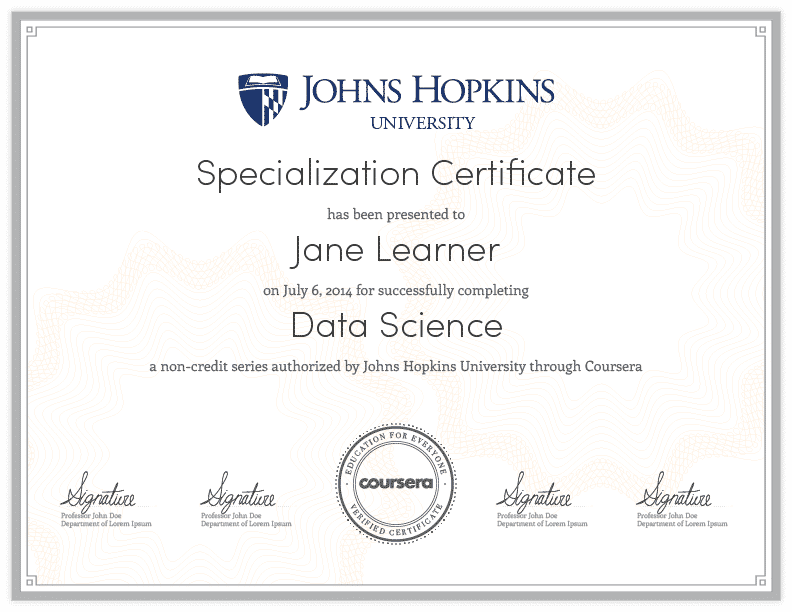
After reviewing Coursera’s courses, it makes sense to move on to Specializations. These are some of the most popular categories of online classes on Coursera because they function similarly to a traditional curriculum. Students develop deep knowledge of a topic through a series of intertwined courses. By the end of the Specialization, they will have an excellent foundation of knowledge, together with a finished student project and Specialization certificate.
What is a Coursera specialization?
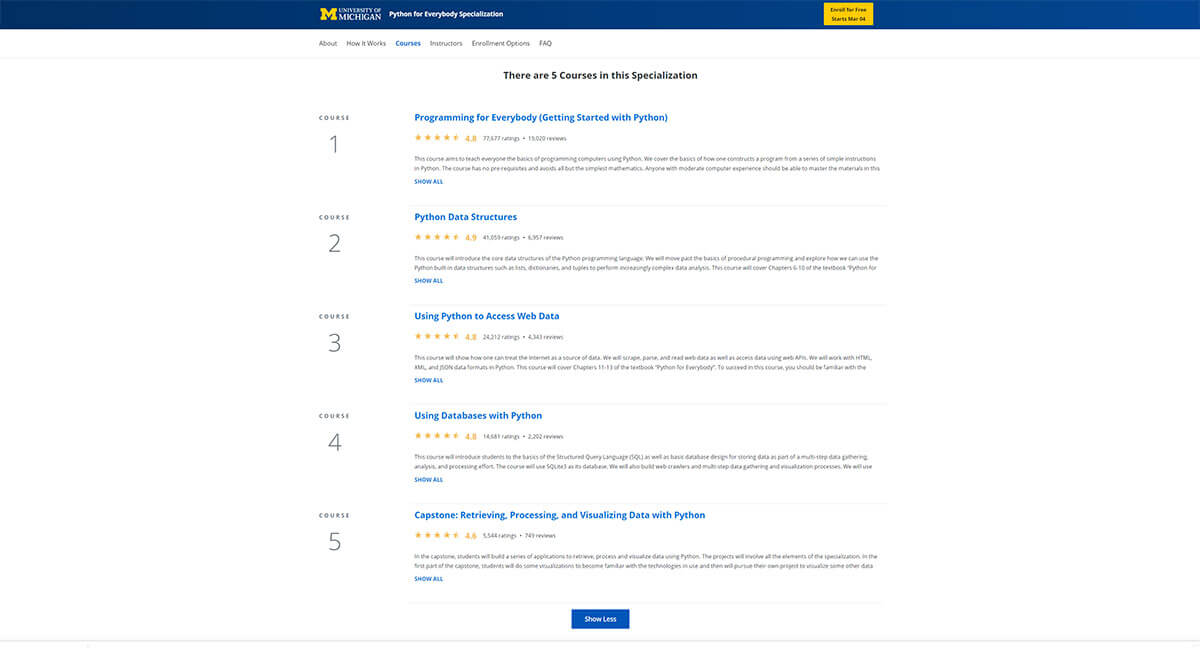
Coursera Specializations are a series of related online courses. For example, one of Coursera’s most popular offerings in this category, the “Python for Everybody Specialization,” includes five courses on the topic of Python programming. It’s also possible to take these five courses individually, but then you would miss out on the Specialization certificate and hands-on project.
Are Coursera specializations worth it?
Yes, Coursera Specializations are worth the investment. Coursera Specializations provide degree-level knowledge at a relatively low monthly cost, and they come from the world’s top universities, such as Stanford University and Johns Hopkins University. If you have a Coursera Plus subscription, all specializations are included.
How do Coursera specializations work?
Coursera Specializations work similarly to regular courses where you have to pass weekly units with lectures, readings, and quizzes. The units CAN be taken in succession quicker than the proposed schedule. Since you are paying for access to Specializations on a monthly basis, you can take a month’s worth of units in one week and save money. Once you have finished all the units of the first course, you are taken to the next courses, until finally arriving at the hands-on Specialization project. After that, you will be awarded a Coursera Specialization Certificate.
Coursera’s Professional Certificate programs
If building a strong resume is one of your end goals, then taking a Professional Certificate program on Coursera will be right up your alley. Upon graduation, these programs give students professional certification from the institution that created the course. Unlike the Specializations that are mainly delivered together with academic partners, the Professional Certificates have been developed with leading corporate partners, including Google, Meta, Microsoft, Palo Alto Networks, and IBM.
However, even if they are delivered by companies, some certificates will give you university credit that you can apply toward your university degree – and the degrees are available to take online on Coursera as well, as a bonus. For example, completing the “Google IT Support” certificate will earn you college credit if accepted to the Bachelor of Science in Computer Science at the University of London and the Bachelor of Applied Arts and Sciences at the University of North Texas. This can be a great deal as it can save you both time and money once you are accepted to the degree.
There are currently hundreds of Professional Certificate programs available on Coursera. We’ve listed a selection of these below, together with their prices. Keep in mind that for the certificates that are included in the Coursera Plus subscription, these prices will essentially be reduced to $33 per month (the subscription cost for an annual plan).
Included with Coursera Plus:
- “Google IT Support” by Google: $51 per month
- “Google IT Automation with Python” by Google: $51 per month
- “Google Project Management” by Google: $51 per month
- “SAS Programmer” by SAS: $51 per month
- “SAS Visual Business Analytics” by SAS: $51 per month
- “TESOL” by Arizona State University: $51 per month
Not included with Coursera Plus:
- “IBM Data Engineering” by IBM: $51 per month
- “IBM Full Stack Software Developer“: $51 per month
- “IBM Back-End Development“: $51 per month
- “IBM Technical Support” by IBM: $51 per month
- “IBM Data Science” by IBM: $51 per month
- “IBM AI Engineering” by IBM: $51 per month
- “IBM z/OS Mainframe Practitioner” by IBM: $51 per month
- “Meta iOS Developer” by Meta: $51 per month
- “Meta Android Developer” by Meta: $51 per month
As you can see, Google and IBM have rather extensive catalogs of certifications to choose from. Google and IBM account for a large share of the catalog. This should also give you an idea of who Coursera’s Professional Certificate programs are largely meant for. It’s for people who want to start new IT careers in large international corporations such as Google and IBM (or in other companies using these companies’ products).
If your end goal is landing a job at companies such as Google or IBM, then getting a professional certificate or two issued by the companies themselves will boost your resume.
Coursera’s MasterTrack programs
In March 2018, Coursera announced its version of micro-credential programs. Dubbed the Coursera MasterTrack Certificates, they were introduced at a time when edX, another massive MOOC website, was becoming dominant in the micro-credential marketplace. These types of micro-credential programs are designed for students who want knowledge on the level of a Master’s degree but without the time and costs that normally come with obtaining one.
What is a Coursera MasterTrack program?
Coursera MasterTracks are university-backed single-semester online certificate programs that last 4 to 7 months. The university in charge of the program issues students who pass the course a MasterTrack Certificate. MasterTrack Certificates can act as a booster to resumes or count as college credit towards a full degree.
Importantly, unlike a normal Master’s program, there is no application process – you can enroll directly. However, the program is not self-paced and you will have to wait for the next cohort to start.
What Coursera MasterTrack programs are available?
Coursera continues to offer a selection of MasterTrack Certificates — graduate-level credentials drawn from top universities’ Master’s programs. Note that the MasterTrack programs are not included in Coursera Plus. The MasterTrack offerings have been reduced greatly in the last couple of years, with mainly Spanish-language Latin American university partners – but with one major exception:
- “Instructional Design” by University of Illinois at Urbana-Champaign: $2,384
This selection of micro-credential programs offered by Coursera is high-quality but not very varied. Currently, some competitors have a considerably better choice of online certification programs. As mentioned before, edX has a far larger and largely English-language MicroMasters catalog — for example, MIT’s Statistics and Data Science MicroMasters, a graduate-level credential that can count toward a full Master’s. However, that is to be expected since edX has been building its micro-credential catalog longer than Coursera has.
Another thing to note is that the cost of these MasterTrack certificates is not exactly cheap – although they are certainly more affordable than following these courses in person at the institutions in question. But the similarly structured edX MicroMasters programs begin at around $1,000. With Coursera MasterTracks, you will be hard-pressed to find anything under $2,000.
Are Coursera MasterTrack certificates worth it?
Whether Coursera’s remaining MasterTracks are worth it depends on the specific program. Because the catalog is now so small, it’s worth comparing any MasterTrack you’re considering against edX’s much broader MicroMasters offering before committing.
For example, an English-language MicroMasters such as MIT’s Statistics and Data Science (offered through edX) is a graduate-level credential that can count toward a full Master’s — the kind of breadth Coursera’s shrinking MasterTrack catalog no longer matches.
edX’s MicroMasters programs also tend to start lower — from around $1,000 — whereas Coursera MasterTracks are rarely under $2,000. That said, price, duration, and the awarding university vary widely from program to program.
So before choosing, compare the specific programs you’re interested in across both platforms — the universities, prices, course difficulty, and duration. Take your time and make an informed decision; that’s my best recommendation.
Coursera’s online degrees
Coursera offers a broad selection of online degrees — both Bachelor’s and Master’s programs from leading universities — making it one of the strongest degree catalogs among the major MOOC platforms.
The demand for online degrees is increasing every year. With more than 6 million students enrolled exclusively in online higher education in the United States as of 2024–25 — about 28% of undergraduates and 45% of graduate students — MOOC websites constantly compete to offer the most appealing solutions to students and universities.
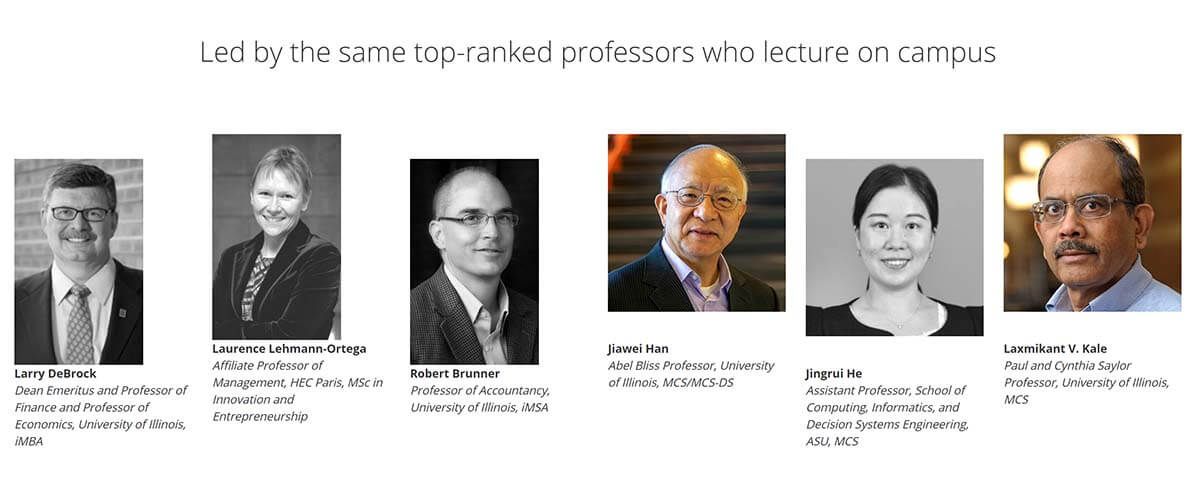
Coursera has been offering online degrees since 2017, which was the year when it released its first two fully online master’s degrees:
- “Online Master’s in Innovation and Entrepreneurship” by HEC Paris
- “Online Master’s of Accounting (iMSA)” by the University of Illinois
In 2018, Coursera added another six fully online degrees (5 Master’s, one Bachelor’s) to their catalog. The lineup of online master’s degrees on Coursera now also included the following programs:
- “Online Master’s of Computer Science“ by the Arizona State University
- “Online Master’s of Public Health“ by Imperial College London
- “Online Master’s of Computer Science in Data Science“ by the University of Illinois
- “Online Master’s of Applied Data Science“ by the University of Michigan
- “Online Master’s of Public Health“ by the University of Michigan
And, this was also the year when Coursera introduced their very first online bachelor’s program:
- “Online Bachelor’s of Computer Science“ by the University of London
The lineup of online degrees on Coursera has been growing since then, with another seven online master’s degrees added into the selection in 2019:
- “Online Master’s of Business Administration“ by the University of Illinois
- “Online Master’s of Global Business Administration“ by Macquarie University
- “Online Master’s of Software Engineering (in Spanish)“ by Universidad de los Andes
- “Online Master’s of Electrical Engineering“ by the University of Colorado Boulder
- “Online Master’s of Computer and Information Technology” by Penn Engineering
- “Online Master’s of Data Science“ by HSE
- “Online Master’s of Data Science“ by University of Colorado Boulder
And, another single online bachelor’s degree was added to Coursera in 2019 (raising the total to 2):
- “Online Bachelor’s of Applied Arts and Sciences” by the University of North Texas
The pace has increased since then, leading to the dozens of online degrees available today.
Are Coursera degrees recognized?
Yes, all online degrees on Coursera are delivered directly by the universities in question and are therefore fully accredited and internationally recognized. Degrees on Coursera are developed by universities from across the globe and then hosted on Coursera. This means that you get the same university-level knowledge from a Coursera degree that you would from a traditional college degree.
Are Coursera degrees worth the price?
Yes – Coursera degrees offer significantly better value than traditional college degrees, and you can expect to save at least 50% to 75% on overall expenses by choosing to learn online. Compared to other online degrees, Coursera’s degrees are priced reasonably, and the price ranges are very similar to competitors such as edX.
Coursera for Business (B2B)
High-quality enterprise online learning solutions are increasingly sought after, which is evident when you look at Coursera for Business.
Coursera for Business partners with major organizations such as Mastercard, Southwest Airlines, and Adobe. Coursera seems set to become the industry leader in corporate e-learning, so what better time than now to review Coursera for Business as a solution for enterprise customers?
What is Coursera for Business?
Coursera for Business is a corporate e-learning service from Coursera. Its aim is to provide corporate training and workforce development through online courses. Through Coursera for Business, employees get access to learning programs from top universities, with university-backed certificates provided upon graduation.
How Does Coursera for Business work?
With Coursera for Business, corporate employees get access to over 7,000 online classes which they can use for building new skill sets and knowledge. Employees also get access to projects, graded assessments, and quizzes, while managers can track the learning progress of employees and provide feedback when necessary. It is basically Coursera Plus for teams but with additional features.
The Enterprise plan which is for organizations larger than 100 employees, brings some extra features to the table:
- Industry skill insights and benchmarking from Coursera
- Course recommendations for employees
- Customer success managers
- LMS integrations (Degreed, Cornerstone, CrossKnowledge, SuccessFactors)
- API integrations
How much does Coursera for Business cost?
Coursera for Business has two different payment plans: Team, and Enterprise. The Team plan costs $400/user/year. The Enterprise plan, aimed at organizations with 100+ employees, provides numerous extra features and costs less per user than the Team plan (at a negotiated price).
Common Coursera complaints (and my honest take)
Before I get into the criticisms, a quick word on where they come from. I’ve spent enough hours on Coursera to have my own gripes, but I also went looking for everyone else’s — trawling Reddit, Trustpilot, the BBB and the usual review sites for the complaints that come up again and again. Keep one thing in mind as you read: almost nobody logs on to write “my course was fine,” but they absolutely will to vent about a charge they didn’t see coming — so the internet makes Coursera look worse than it really is. That dismal Trustpilot score, for instance, is almost entirely a billing story, not a learning one. For each recurring complaint below, I’ve added my own honest verdict on how much it should actually worry you.
And I didn’t stop at writing them up. On June 19, 2026, I sent this entire list of complaints straight to Coursera and invited them to respond to each one. I’m genuinely hopeful they’ll reply with their side of the story — though there’s no guarantee they will — and if they do, I’ll publish their responses right here, point by point, next to my own take.
1. Subscription billing is confusing
What people say: A purchase they thought was one-off turned into a recurring monthly charge.
This one’s largely fair. Here’s the thing people miss: unlike a one-and-done Udemy purchase, most of Coursera’s certificates and Specializations are billed as a monthly subscription that keeps running until you finish — or until you cancel. If you’re quick, that’s brilliant; you might pay for a single month. If life gets in the way and you stall, that “$49 course” quietly becomes $49 every month until you cross the finish line. I genuinely don’t think it’s a scam — it’s just a different way of charging that the checkout doesn’t flag clearly enough, and it tends to catch out people who aren’t used to subscriptions. My advice: look for the little “per month,” be honest with yourself about how many months you’ll realistically need, and audit the course for free first — you may well find you don’t need to pay at all.
2. The annual plan auto-renews without clear warning
What people say: Being charged another full $399 year with no reminder.
Fair, and worth taking seriously. Coursera Plus Annual renews itself a year later, and while that’s technically disclosed, it’s buried in the kind of fine print none of us actually read — and plenty of learners say they got no heads-up before the $399 landed again. I don’t think this is just grumbling, either: there was a 2024 class-action lawsuit arguing Coursera’s renewal and cancellation setup didn’t meet US auto-renewal law (an allegation, mind you, not a proven verdict — but you don’t attract a suit like that unless a lot of people are upset). The fix is painless, so do it the day you sign up: switch auto-renew off (you keep access until the year is up anyway) or drop a reminder in your calendar a month before the renewal date.
3. Refunds are harder to get than the “14-day” policy implies
What people say: Refunds denied even after cancelling within 14 days.
Half fair, half fine print. The “14-day money-back guarantee” is real, but it’s narrower than most people assume, and that’s where the anger comes from. Three things catch people out: the 14 days runs from your first payment, not from a renewal; claiming your course certificate kills the refund on the spot, even on day two (so no finishing the course and then asking for your money back); and Guided Projects — plus a few other bits — aren’t refundable at all. So a good chunk of the “they denied my refund!” stories are really a run-in with the small print rather than Coursera misbehaving. That said, I’ve come across enough credible cases of refunds being fumbled even when the person clearly qualified that I won’t pin it all on user error. Play it safe: jot down your purchase date, ask early, and don’t claim that certificate until you’re certain you’re keeping the course.
4. Slow or unhelpful customer support
What people say: Chatbot loops and cases closed without resolution, especially for billing.
Sadly, this one rings true. It’s the hardest complaint to measure — nobody emails support to say thanks, so the reviews here will always lean negative — but the same story turns up far too often across Trustpilot, the BBB and Reddit: chatbots sending you in circles toward buttons that don’t exist, slow email replies, and billing cases quietly closed without a human ever looking. For free, browse-at-your-own-pace learning, you’ll probably never need support at all. It’s when money’s involved — a dodgy charge, a refund — that the gap really hurts, which is of course exactly when you need a real person. If you do hit a wall, keep everything in writing (cancellation confirmations, dates), be politely persistent, and remember your card provider can dispute a charge Coursera won’t. In short: I love it for learning, but go in assuming a billing problem might take some fighting.
5. Coursera Plus doesn’t include everything
What people say: Subscribed expecting “everything,” then hit paywalls.
True — though it’s all in the terms. Coursera Plus is sold as “unlimited access to 10,000+ courses,” which is accurate but isn’t quite the same as “all of Coursera.” Roughly a tenth of the catalogue sits outside Plus, and the big-ticket stuff — degrees, MasterTrack certificates and some Professional Certificates — is excluded outright. The sting comes when someone subscribes specifically to earn one certificate and only afterwards discovers it wasn’t covered. It’s disclosed, sure, but that breezy “unlimited” sets people up to expect more than they get. Honestly, it’s a thirty-second check: open the page for whatever you’re after and make sure it carries the “Included with Coursera Plus” badge before you pay — and if a single excluded certificate is your whole reason for subscribing, Plus might not save you a penny.
6. Peer-graded assignments are slow or low-quality
What people say: Long waits for peers to grade, and feedback that’s unhelpful or off-rubric.
A real weakness — but one every MOOC shares. In a lot of courses, the assignments that actually prove you’ve learned something are peer-graded: you hand yours in, wait for fellow learners to mark it against a rubric, and mark theirs in return. Two things go wrong. In quieter or older cohorts there simply aren’t enough people around, so your work can sit there for days and hold up your progress — properly annoying when you’re paying by the month. And the feedback is a bit of a lottery: sometimes genuinely useful, sometimes a one-line “nice job” that ignores the rubric entirely. To be fair to Coursera, this is baked into the MOOC model — a computer can’t grade an essay and an instructor can’t mark ten thousand of them — but they haven’t cracked it either. In practice the big, popular courses suffer far less; submit early in your billing month to give yourself a buffer; and Coursera Coach (their AI helper) can at least give you quick, if unofficial, feedback while you wait.
7. The monthly model pressures you to rush
What people say: Paying monthly creates pressure to finish fast, which clashes with slow peer grading.
There’s something to this. Because Specializations and certificates bill monthly, what you actually pay is “price × however many months you take” — so there’s a quiet nudge to hurry, and that nudge runs straight into the slow peer-grading I just mentioned. If you’re studying full-time and disciplined, it’s almost a perk: go fast, pay little. If you’re squeezing study in around a job, it can turn learning into a race against your next invoice, which isn’t much fun. I’d call it a design trade-off rather than a flaw, and it’s manageable once you know it’s there — Coursera lets you tear through a month’s worth of material in a week or two, so a focused learner can knock out a typical Specialization course in a billing cycle or two, and you can always cancel and pick it back up later (your progress is saved). And if deadlines stress you out? Just audit it and forget the clock.
8. Pricing has crept up, and some once-free things now cost money
What people say: Monthly pricing is higher than some rivals, and content that used to be free is now paid.
Partly fair — it’s really two complaints in one. On price alone, the gripe holds up: month-to-month access (around $59 for Plus, or per-program rates) is steeper than several rivals. The other half is nostalgia — back in the early MOOC days a lot more was free, and the drift toward paid certificates and subscriptions feels, to long-time users, like the drawbridge going up. Both are true as far as they go, but they overlook two things: the annual Plus plan ($399 a year, about $33 a month) is where the value really sits if you take more than a course or two, and the auditing — every lecture and reading — is still completely free. You’re paying for the graded work, the certificate and the convenience, not for the teaching itself. Match the plan to how you actually learn: audit for free, buy one course outright if that’s all you want, and only go annual Plus if you’ll genuinely work through a stack of programs.
9. Free auditing is limited, and some content can feel dated
What people say: The free tier withholds too much, and a few courses feel out of date.
Accurate — but mostly by design, with one fair point. The “auditing is too limited” line slightly misreads the deal: auditing hands you all the video lectures and readings for free and only holds back the graded assignments, quizzes and certificate. That’s the trade for paying nothing, not a bait-and-switch, and it’s still one of the more generous free options out there. The dated-content worry has more to it: courses are made with university and company partners who refresh on their own schedules, so some do fall behind — a fast-moving subject like cloud or data tooling can look its age, while the fundamentals (statistics, writing, core programming) barely date at all. Before you enrol, glance at the course’s “last updated” date and skim a few recent reviews, and for anything tool-specific, lean toward courses that have been freshened up in the last year or two.
10. Are the certificates actually worth anything?
What people say: MOOC certificates aren’t “real” qualifications, and popular ones (e.g., Google) are now everywhere.
Mostly overblown — but not entirely. There are two worries tangled together here. “They’re not real degrees” is true, but rather misses the point — a Professional Certificate was never trying to be a degree; it exists to signal specific, job-ready skills, and Coursera’s own 2025 Learner Outcomes Report has 91% of career-focused learners reporting that something good came of it (a raise, a promotion, a new job), with the Google, IBM and Meta certificates getting named in real entry-level and career-change hiring. The “everyone’s got a Google cert now” worry has more bite — the most popular ones are common enough that they won’t make you stand out on their own anymore. The honest answer is that a certificate is necessary but not sufficient: it gets you into the room, but it’s your portfolio, your projects and the way you talk about them that actually win the job. Treat it as the floor, not the finish line.
Review conclusion: Is Coursera worth it?
Coursera is an excellent MOOC website that has earned its place as a leader in the industry.
For taking individual online courses or groups of courses (specializations), I consider Coursera one of the best websites out there. All their courses are accredited, and internationally recognized universities and industry partners issue all certificates. Well-built quizzes, high-quality video lectures, and relevant reading materials are something I expect from all Coursera courses, and I have yet to be disappointed. The opportunity to audit most of Coursera’s online classes for free is also a splendid opportunity for many students.
As for Coursera’s new micro-credential solution, the MasterTrack programs, my verdict becomes a bit more complicated. On the one hand, the MasterTrack programs offer degree-level knowledge for a fraction of the price of an actual degree. But on the other hand, competitors such as edX and FutureLearn offer programs that can sometimes be more content-rich and affordable. Comparing the specific programs you are interested in across platforms is essential.
The selection of online degrees available on Coursera is one of the very best out there. With competitive price points and excellent universities backing these degrees, Coursera certainly becomes one of the most appealing online learning platforms.
The one thing I’d weigh before signing up is the billing: as the complaints above lay out, it’s the subscriptions, auto-renewal and refund fine print that trip people up — far more than the teaching ever does. Go in with your eyes open (audit free first, note the renewal date) and the learning itself rarely disappoints. All in all, Coursera is absolutely worth a strong recommendation. They have some of the best online courses in the world, and any serious e-student can’t afford to miss out on their online class selection. Andrew and Daphne, the founders of Coursera, have really achieved something historical with this website. I’m very excited to see what the future has in store for the site.
Coursera alternatives
| Platform | Best for | Free option | Starting price | Certificates | Rating |
|---|---|---|---|---|---|
| edX | University MicroMasters & MITx/HarvardX courses | Free to audit | Free; verified certs paid | University-backed, accredited | 4.4/5 |
| Udemy | Affordable one-off skills courses | Some free courses | ~$15–$50/course | Completion only | 3.9/5 |
| Udacity | Career-focused tech Nanodegrees + mentorship | Limited free courses | Subscription (premium) | Nanodegree (industry) | 4.7/5 |
| LinkedIn Learning | Business & creative skills + LinkedIn integration | 1-month free trial | ~$39.99/mo | Completion (LinkedIn) | 4.4/5 |
| FutureLearn | UK university short courses | Free to audit (limited) | Subscription / per-course | University & industry-backed | 4.5/5 |
Coursera FAQ
Is Coursera worth it?
For most learners, yes — especially if you audit courses for free or take several a year on Coursera Plus. The university- and company-backed certificates carry real weight, and a single one-off course is often cheaper bought individually or audited free.
Does Coursera have a free trial?
Coursera Plus includes a 7-day free trial on the monthly plan — cancel within the trial and you are not charged. Most individual courses can also be audited for free indefinitely.
Can I get a refund from Coursera?
Coursera Plus Annual is refundable within 14 days of payment; after that it is non-refundable. Refunds typically take 7 to 10 business days.
Are Coursera certificates recognized by employers?
University- and company-issued certificates carry real weight, and the Google and IBM career certificates are the most recognized of the bunch — both were built around in-demand job skills and show up by name in many entry-level IT, data, and project-management listings. Coursera’s online degrees are fully accredited by the awarding universities, so they hold the same value as an on-campus qualification. That said, a certificate on its own will not land you a job; treat it as credible evidence of your skills to pair with a portfolio and real-world experience.
How much does Coursera cost?
Individual courses run $29 to $99 (often free to audit); Coursera Plus is $59/month or $399/year; most Professional Certificates are about $51/month; online degrees range roughly $9,000 to $45,000.
Is financial aid available on Coursera?
Yes. Coursera offers financial aid grants (not loans) that can waive up to about 90% of the cost of many courses and certificates. Apply from the course page; review takes up to about 16 days, and you cannot combine it with a free trial.
Does Coursera use AI?
Yes — Coursera Coach, an AI learning assistant built on Google Gemini, is included with Coursera Plus and select certificates. It explains concepts, quizzes you, summarizes lessons, and supports Socratic-style practice.
Coursera vs edX — which is better?
Both are university-backed and let you audit most courses for free, so the choice comes down to what you want. Coursera has the deeper catalog of job-focused Professional Certificates (Google, IBM, Meta) and a strong line-up of full online degrees, plus the Coursera Coach AI assistant. edX leans more academic, with a broader, largely English-language MicroMasters catalog from the likes of MIT and Harvard that can ladder into a full Master’s. For career certificates or a degree, Coursera usually wins; for graduate-level micro-credentials, edX has the edge. See our edX review for the full comparison.
Learn more: Coursera course & certificate reviews
Looking to get a better understanding of how Coursera courses function in practice? Here at e-student.org, we’ve taken a hands-on look at dozens of individual Coursera certificates and specializations. Browse our in-depth reviews by provider:
IBM Professional Certificates
- IBM AI Engineering Professional Certificate
- IBM Applied AI Professional Certificate
- IBM Applied DevOps Engineering Professional Certificate
- IBM Back-End Development Professional Certificate
- IBM Cybersecurity Analyst Professional Certificate
- IBM Data Analyst Professional Certificate
- IBM Data Analytics with Excel and R Professional Certificate
- IBM Data Engineering Professional Certificate
- IBM Data Science Professional Certificate
- IBM Data Warehouse Engineer Professional Certificate
- IBM DevOps and Software Engineering Professional Certificate
- IBM Front-End Developer Professional Certificate
- IBM Full-Stack Software Developer Professional Certificate
- IBM IT Project Manager Professional Certificate
- IBM IT Support Professional Certificate
- IBM Machine Learning Professional Certificate
- IBM Project Manager Professional Certificate
Google Professional Certificates
- Google Business Intelligence Professional Certificate
- Google Cloud Data Engineer Professional Certificate
- Google Cloud Developer Professional Certificate
- Google Cloud DevOps Engineer Professional Certificate
- Google Cloud Engineer Professional Certificate
- Google Cybersecurity Professional Certificate
- Google IT Automation with Python Professional Certificate
- Google IT Support Professional Certificate
- Google Project Management Professional Certificate
Meta Professional Certificates
- Meta Android Developer Professional Certificate
- Meta Back-End Developer Professional Certificate
- Meta Front-End Developer Professional Certificate
- Meta iOS Developer Professional Certificate
Microsoft
- Microsoft Azure Developer Associate Professional Certificate
- Microsoft Cybersecurity Analyst Professional Certificate
- Microsoft 365 Fundamentals Specialization
Salesforce Professional Certificates
- Salesforce Sales Development Representative Professional Certificate
- Salesforce Sales Operations Professional Certificate
AWS
Specializations
Related Coursera guides
Get 40% off your first year of Coursera Plus Annual — unlimited access to 10,000+ courses (new subscribers only)
Read Next
Originally published January 16, 2023